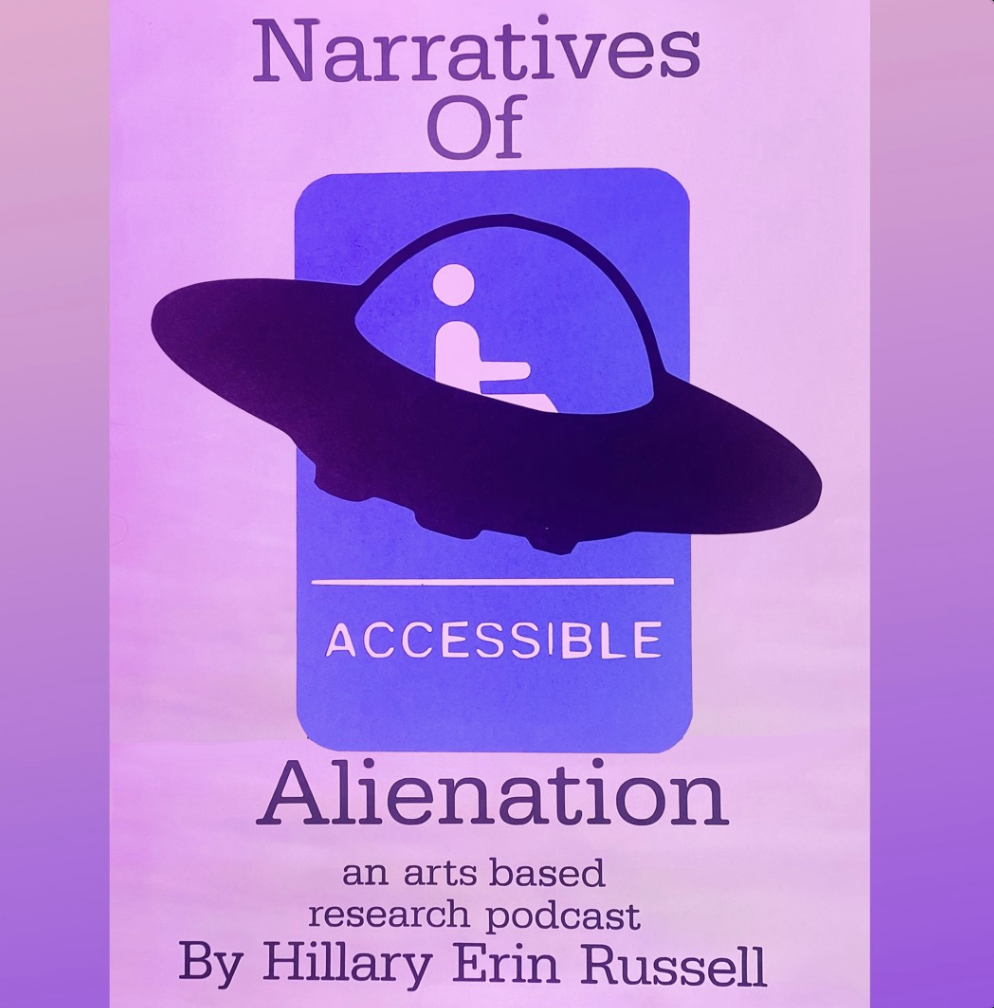
Narratives of Alienation
Narratives of Alienation is an art-based research project I began during my Ph.D. program. I examined the ways in which alienness and alienation could be represented in various ways. My love of sound art drew me to the exploration of sound, dis/ability, and speculative fabulation for my dissertation project. Below is an excerpt from my dissertation regarding the project. I intend to continue to build the project as I interact and engage with fellow individuals with dis/abilities. Through art we can start meaningful conversations that have to power to spark significant change. These sonic episodes became a space for participants to fabricate new worlds and understandings of themselves. Below are links to the individual episodes. If you are interested in participating or have questions please email me at narrativesofalienation@gmail.com.
As an individual with a dis/ability, I needed representations that reflected my embodied experience of living with a dis/ability. Moreover, I needed opportunities to tell my stories and rework my representation in specific ways. As a result of my cognitive dis/ability, my capacity to communicate was greatly impaired. As an infant, I suffered from health issues that exacerbated my dis/abilities. Often, I was othered in public spaces and throughout grade school. It was almost impossible to find complex media representations of individuals with dis/abilities that were not based on binaries such as human/less-than-human, abled/dis/abled, and self/other. Most representations smacked of incompleteness, lack, deprivation, or incapacitation. I asked myself as an adult, how could I produce a space to think about my embodiment differently and share a conversation about it with others? This is where my dissertation project began.
The Narratives of Alienation (Alien) podcast project highlights the voices of individuals with dis/abilities through storying—crafting stories while telling them. Using sound, I, along with participant volunteers, collaboratively created narratives that reworked what it means to feel alien using metaphors associated with dis/ability. The narratives included soundscapes, characters, and individual story episodes. Within these, the alien, alien technology, and the alien planet served as metaphors that offered a venue for narrative or counter-story. This created a platform to feel through others, and also enabled a way of making sense of oneself by concocting specific worldly reconfigurations or possibilities. It offers a way of seeing and imagining futurities in response to ableism. These narratives are presented as podcasts through a process of collection, rearrangement, production, and sharing. The podcast format highlights sound art and collaboration and moves art beyond a representational role or an aesthetic object, to a performative role, a transport station, or a working-through, which offers potentialities (Ettinger, 2005). The making and collecting of these stories begin to answer these questions: What is otherness in relation to dis/ability? How can art be used to negotiate otherness in relation to dis/ability? What happens in our encounters with each other? Can rethinking through speculative fabulation formulate an ecology of care?